
Horizontal Gaze Nystagmus (HGN) DUI Test
DUIs in Idaho and That Eye-Jerky Test: The Lowdown (HGN in Boise & Ada County)
Ever heard of the Horizontal Gaze Nystagmus (HGN) test? It's one of the three roadside “standardized field sobriety tests” Idaho officers often use when they think a driver might be impaired. NHTSA (the National Highway Traffic Safety Administration) backs the test as part of its standardized battery, but it isn't perfect—and when it's done wrong, it's fair game to challenge in Ada County court.
If you were pulled over in Boise, Meridian, Eagle, or Garden City and found yourself doing the HGN “follow-the-pen” routine, call Boise DUI at 208-392-1964. Our Ada County DUI defense team reviews video, training records, and the fine print to make sure the test was done by the book—and that the results are even admissible in the first place.
Quick refresher: what the HGN test is (and isn't)
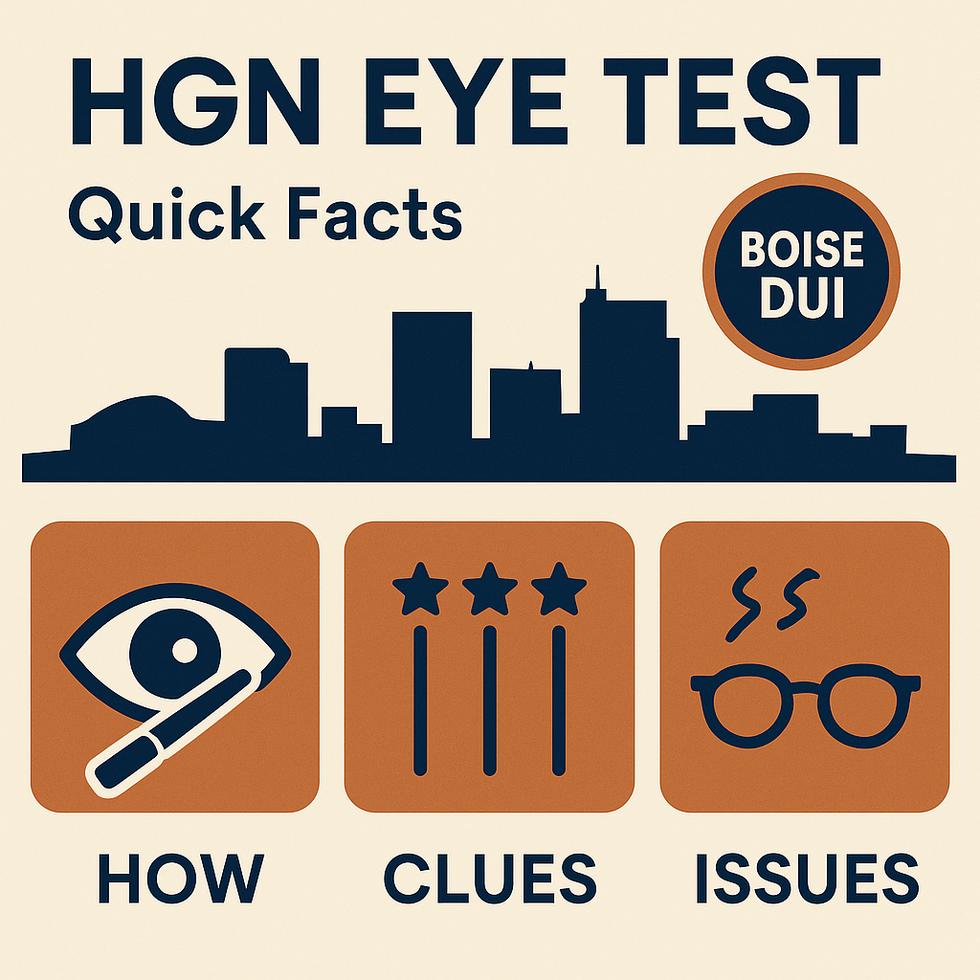
HGN looks for an involuntary jerking of the eyes as they track a stimulus side-to-side. Officers watch for three “clues” in each eye (six total): lack of smooth pursuit, distinct/sustained nystagmus at maximum deviation, and onset of nystagmus before 45 degrees. NHTSA teaches that four out of six clues suggests a BAC at or above the per-se limit when combined with proper administration. Older NHTSA manuals tied validation to 0.10% BAC; modern training materials and many agencies (including the California Highway Patrol summary of the current curriculum) treat four-of-six clues as consistent with ≥0.08%. The key is that the test must be standardized and performed correctly.
What Idaho law actually says about HGN evidence
Idaho courts allow HGN evidence—but with limits. The Idaho Supreme Court recognized HGN's scientific underpinnings in State v. Garrett and later clarified that, with a proper foundation (i.e., a qualified tester and correct procedures), HGN can come in under Idaho Rule of Evidence 702. However, Idaho courts restrict how far the testimony can go: an officer can't use HGN to pin you to a specific BAC number.
In State v. Besaw (Idaho Court of Appeals), the court reiterated that HGN testimony is admissible under Rule 702 if the state shows the tester is properly qualified—and again cautioned that the inferences are limited. The court contrasted HGN (scientific) with the walk-and-turn or one-leg-stand (non-scientific observations). That matters at trial: the prosecutor can't turn HGN into a pseudo-breath test.
Idaho's Supreme Court went even further in State v. Hill, throwing out a felony DUI conviction because the officer testified that vertical nystagmus “meant” the defendant was over a specific BAC. Bottom line: HGN can be a piece of the puzzle, but Idaho appellate courts don't let it morph into a number.
Idaho's DUI rule of the road (why 0.08% matters)
Idaho Code § 18-8004 makes it illegal to drive while “under the influence” or with an alcohol concentration of 0.08% or more—two different ways to prove the same crime. HGN sits in the “under the influence” evidence bucket; it doesn't replace a chemical test, and it can't be used to announce your exact BAC to a jury.
How HGN should be done (and common ways it goes sideways)
NHTSA's standardized process isn't a suggestion—it's the playbook. Among other things, the officer should check for equal pupil size, equal tracking, and resting nystagmus, hold maximum deviation long enough, and move the stimulus slowly enough to find “onset prior to 45°.” The test should be done in conditions that don't interfere with observation. If the officer rushed the passes, used jerky movements, or blasted you with patrol-car strobes, that's fertile ground for a challenge.
Even when perfectly administered, there are non-alcohol reasons eyes can jerk: inner-ear issues, certain neurological conditions, and a number of medications and drugs (including several anticonvulsants). That's why medical history, prescriptions, and any relevant ER or primary-care records can matter in a Boise DUI defense.
Ada County–specific: how we attack a shaky HGN in Boise courts
We handle DUI cases daily across the Ada County Magistrate Court in Boise. If HGN played a role in your arrest, here's how we pressure-test it for court:
-
Training & credentials. We pull the officer's NHTSA/SFST and ARIDE/DRE training records to confirm qualification under Idaho Rule 702. If the training is stale, incomplete, or the officer deviated from the standardized script, we move to limit or exclude. Idaho appellate decisions require proper foundation—qualification plus correct method under Besaw.
-
Body-cam and dash-cam timing. We scrub video for pass speed, hold times at maximum deviation, and stimulus distance, pausing frame-by-frame to show the court what actually happened roadside on I-84, State Street, Chinden, Broadway, or wherever BPD/ACSO stopped you. NHTSA's own materials give us the yardstick.
-
Environment. Uneven shoulders, wind, rain, bright headlights, emergency strobes, and heavy traffic can corrupt the observation. If conditions weren't controlled, we argue the HGN “clues” don't carry weight. NHTSA notes surface/conditions matter across the SFST battery.
-
Medical & meds. We match symptoms with documented non-alcohol causes of nystagmus and, when appropriate, use treating-provider records or expert testimony to show alternative explanations.
-
Keep BAC numbers out of HGN. If the State tries to turn HGN (or vertical nystagmus) into a BAC value, we cite Hill and move to strike or seek a limiting instruction. Jurors can hear “indicator of impairment,” not “this equals .10.”
“But the officer said four of six clues—am I sunk?”
Not necessarily. NHTSA's validation research shows HGN is the most predictive of the three SFSTs, but it's not a breath test and it isn't infallible. Four-of-six clues can support probable cause, yet Idaho law still requires proper foundation and doesn't let an officer testify that HGN alone proves a specific BAC. Context—your driving, your statements, your other tests, the environment, and your medical profile—matters in Ada County courtrooms.
Why local experience matters in Boise DUI cases
Every courthouse has rhythms. In Ada County, DUI cases move quickly from arraignment to pretrial, and prosecutors rely heavily on SFSTs plus a chemical test. A smart defense treats HGN as a technical test: we attack the science, the procedure, and the attempt to over-sell it to a jury. That's often where leverage for dismissals, suppression, or favorable plea terms comes from—especially when video undercuts the paper report.
Bottom line
Roadside tests aren't the final word. In Idaho, HGN can be admissible only if the officer was qualified and followed the standardized method—and even then, it can't be used to tell the jury your exact BAC. If HGN helped drive your Boise arrest, we'll dissect the video, the training, and the conditions to see whether the “clues” hold up in an Ada County courtroom.
Need help now? Call Boise DUI at 208-392-1964 for a free, no-pressure case review. We defend DUI cases across Boise, Meridian, Eagle, Garden City, and the rest of Ada County—day in, day out.