
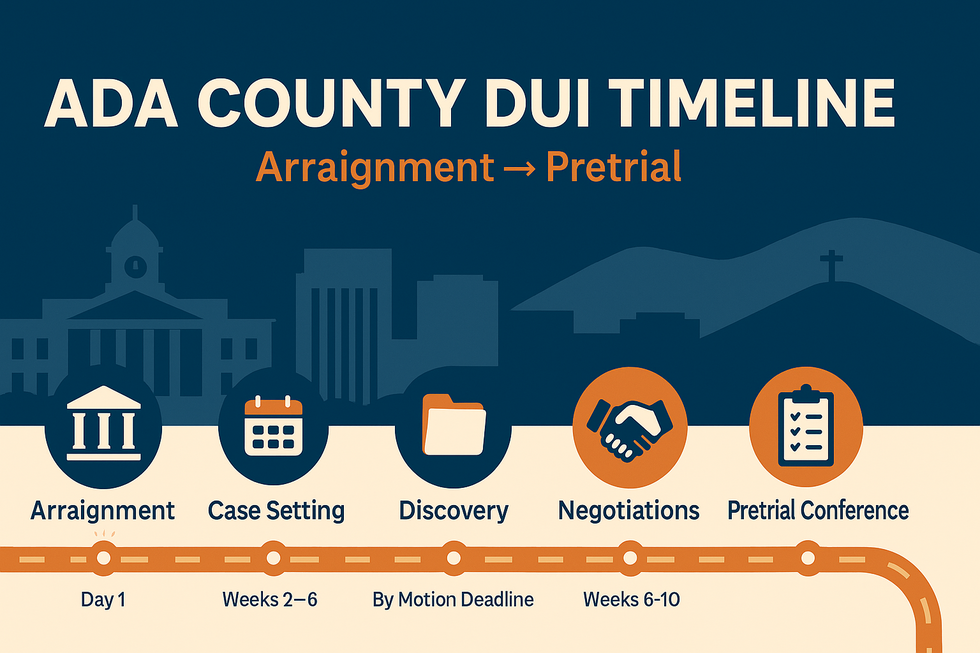
Getting a DUI in Ada County can make the next few weeks feel like a blur. You'll hear about “arraignment,” “ALS,” discovery, and pretrial conferences—often before you've even caught your breath. This guide lays out the typical Boise/Ada County misdemeanor DUI path, the legal anchors under Idaho law, and the practical steps we walk clients through to protect both their license and their case.
Day 0–7: The most urgent deadline (ALS)
If you were served with an Administrative License Suspension (ALS) notice, you have a short window to request a hearing under Idaho Code § 18-8002A. Missing that request triggers an automatic suspension even if the criminal case is later reduced or dismissed. The ALS timing is independent from your court dates, which is why we file the ALS hearing request immediately and start collecting the breath or blood testing paperwork right away.
Key documents to gather immediately: your citation, ALS notice, temporary permit, bond receipt, and any paperwork about testing or refusal. The sooner we see them, the better we can plan your next steps.
Your first court date: Arraignment in Ada County
Most misdemeanor DUI cases begin in the Ada County Courthouse (4th Judicial District, Magistrate Division). At the arraignment, the judge advises you of the charge under Idaho Code § 18-8004 or § 18-8005 (if charged as an “excessive” based on a higher BAC), explains your rights, and asks for a plea. We nearly always enter a not guilty plea at this stage. Doing so preserves defenses, triggers the discovery process under Idaho Criminal Rule 16, and allows time to evaluate the evidence before making any decisions.
The court will set conditions of release. Common terms include: no alcohol or non-prescribed drugs, random testing, obey all laws, and appear for court as directed. If the judge imposes an ignition interlock as a condition of pretrial release, we make sure you understand how to install and maintain it so you're not accused of a violation you didn't intend.
Who prosecutes the case?
In Boise-area DUI cases, prosecution is usually by the Boise City Attorney (for Boise and Meridian cases) or the Ada County Prosecuting Attorney (for Sheriff cases and unincorporated areas). Knowing which office has your file helps us anticipate plea-set expectations, what documentation they want to see, and how quickly lab results tend to arrive.
Discovery: What evidence we demand and why
After arraignment, we send a discovery demand under Idaho Criminal Rule 16. For DUI cases that typically includes:
-
Patrol car and body-worn camera video
-
Dispatch audio and CAD logs
-
Breath testing records, maintenance logs, and simulator solution reports
-
Blood draw paperwork, chain of custody, and lab reports
-
Field sobriety test notes and any standardized testing forms
-
Officer training records relevant to DUI investigation and breath testing
Why this matters: challenges often turn on how the stop occurred, what the officer saw and recorded, and whether the testing process complied with Idaho's requirements. For breath tests, we look closely at fifteen-minute observation periods, instrument accuracy checks, and any burp/regurgitation or medical issues. For blood tests, chain-of-custody gaps and lab method details can make or break admissibility.
Implied consent, refusals, and how they affect strategy
Idaho's implied consent framework (Idaho Code § 18-8002) authorizes officers to request breath or blood testing after a lawful DUI arrest. A refusal triggers separate consequences under § 18-8002A, including license suspension and, in some situations, mandatory ignition interlock if you later seek restricted privileges. If your case involves a refusal, we weigh the pros and cons of a suppression motion, the likelihood of the State proving a valid request and advisement, and how the refusal will play at trial.
Pretrial conference: What actually happens
The pretrial conference is a working meeting—usually with the prosecutor and Judge—where we discuss discovery status, lab results, potential motions, treatment progress, and any plea framework. In Ada County, courts expect defense counsel to come prepared. Showing proof of an alcohol evaluation and prompt enrollment in recommended classes can meaningfully improve outcomes, especially on first-offense cases. Idaho Code § 18-8005 governs sentencing ranges; demonstrating early compliance and risk-reduction can influence where within that range your case should land if you decide to resolve.
If the evidence raises constitutional issues (for example, a questionable traffic stop or problems with the breath test procedure), we set an evidentiary hearing and litigate a motion to suppress before any trial date. Many Ada County cases are resolved only after those issues are aired and ruled upon.
Remote appearances and logistics
Ada County continues to utilize virtual appearances in some settings. Your notice or the court's online calendar typically indicates whether Webex is authorized. We advise clients to log in early, test audio/video, and join from a quiet location. Missed appearances can trigger warrants, even on a misunderstanding, so we confirm attendance in writing with you after each setting.
Sentencing overview (if you choose to resolve)
If you accept a negotiated resolution or are found guilty, sentencing in DUI cases draws from Idaho Code § 18-8005 (jail range, fines, license suspension) and the court's general authority to suspend a sentence and place you on probation under § 19-2601. Typical terms may include alcohol treatment, a victim panel, community service, and—depending on the conviction and BAC—ignition interlock after license reinstatement. We build a plan that minimizes work disruption and uses local alternatives when appropriate.
Plain-English checklist (first 14–45 days)
-
Request ALS hearing now under § 18-8002A if you received an ALS notice.
-
Calendar arraignment and every court date; arrive early (or log in early if remote).
-
Hire counsel quickly so discovery can be demanded and preserved.
-
Start evaluation/treatment promptly; bring proof to pretrial.
-
Save everything: testing receipts, IID service logs (if applicable), and certificates.
-
Don't self-sabotage: no new police contact, no missed tests, and ask before traveling.
How our Boise DUI team helps
We appear with you at arraignment, file your ALS request, demand and review discovery under Rule 16, and map the most efficient path—whether that's negotiating from a position of strength or setting your case for motions and trial. We keep the focus on your life: your license, job, and family. If a resolution makes sense, we work to structure a sentence that uses community-based options whenever possible and positions you to finish probation successfully. Give us a call today to set up a free consultation to see how we can help.

Comments
There are no comments for this post. Be the first and Add your Comment below.
Leave a Comment