
“How Long Can They Keep Me?” — Idaho's Rule on Prolonged DUI Stops (Rodriguez) and What It Means in Ada County
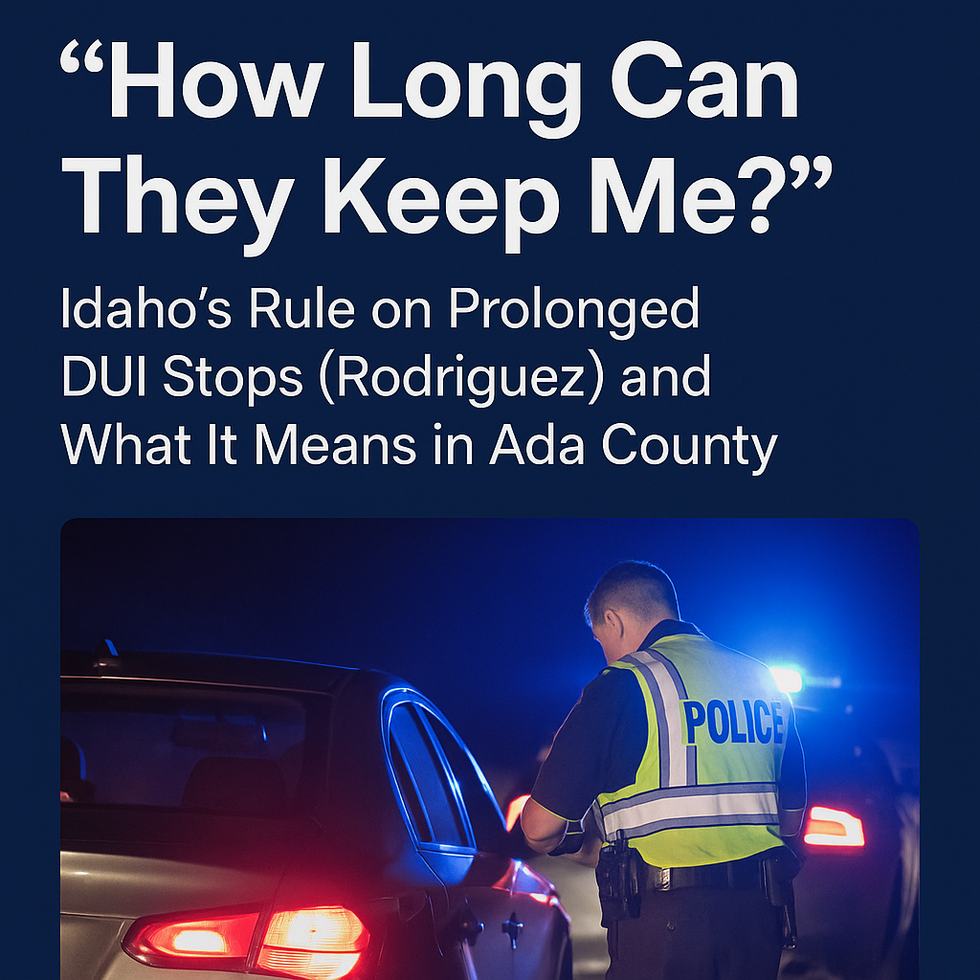
If you were stopped in Boise or anywhere in Ada County and the encounter seemed to drag on, you're not imagining it—the length of a traffic stop matters legally. The U.S. Supreme Court's decision in Rodriguez v. United States and Idaho cases interpreting it control how long officers can keep you while they “work the ticket.” When a stop is stretched for unrelated investigation without fresh, articulable suspicion, evidence can be suppressed.
Below is a plain-English, Ada County–specific guide to the prolonged-stop rule, the tasks officers are allowed to do, what counts as an unlawful detour, and how we document and challenge these issues in DUI cases.
The core rule:
The Supreme Court held that “a police stop exceeding the time needed to handle the matter for which the stop was made violates the Constitution's shield against unreasonable seizures.”
Idaho's appellate courts have adopted that principle and described it as “broad and inflexible”—meaning even a de minimis detour can be unconstitutional if it adds time not tied to the stop's mission.
What officers can do during a Boise traffic/DUI stop
When the stop is justified by a traffic infraction, the officer's authority ends once the tasks tied to that infraction are—or reasonably should be—finished. Legitimate tasks include ordinary safety and identification steps, like checking your license/registration, running warrants, confirming who owns the car, and writing the citation. Those are part of the stop's “mission.”
If, while diligently pursuing those tasks, the officer develops new reasonable suspicion of a different crime (for example, specific facts suggesting DUI beyond a simple speeding ticket), the stop may be extended to investigate that new suspicion. Idaho decisions recognize this limited extension, but the State must point to specific, articulable facts—not a hunch.
What an unlawful “detour” looks like
Idaho cases applying Rodriguez identify some common problem areas:
-
K-9 delays. Calling for or waiting on a drug dog is not part of the traffic-ticket mission. If that request or wait adds time, it's unlawful unless officers already had new reasonable suspicion. Idaho appellate decisions have found even seconds-long radio detours can violate the rule if they prolong the stop.
-
Off-mission questioning. Prolonged questioning about unrelated criminal activity (without new reasonable suspicion) can also cross the line if it adds time beyond what's needed to handle the ticket.
-
“Bonus time” myth. Officers don't earn extra minutes just because they move quickly on ticket tasks. The question is whether the overall duration was extended for an unrelated aim.
How this applies to Ada County DUI stops
A routine speeding stop in Meridian can lawfully grow into a DUI investigation if the officer documents specific impairment clues (odor, slurred speech, admission of drinking, driving pattern, etc.). But the officer cannot pause ticket work to pursue off-mission investigations (e.g., drug inquiries) unless new reasonable suspicion emerges—and any detour that adds time becomes the constitutional problem Rodriguez warns about.
In practice, our motions often focus on the timeline more than labels. For example, if the officer stopped writing the ticket to radio for a K-9 or to quiz you about unrelated drugs, we measure how long that added—and whether, without that detour, the ticket, or DUI tasks legitimately tied to the stop, would already have been complete. Idaho appellate courts have repeatedly framed the “critical question” as whether the detour prolonged the stop.
Building the proof: what we request and why
Challenging a prolonged stop lives or dies on documentation. Early in your case, we demand and analyze:
-
Dash/body-cam video to chart the minute-by-minute sequence (lights on, initial contact, license return, ticket drafting, FSTs, K-9 arrival).
-
Dispatch audio/CAD logs to see precisely when a K-9 was requested and when results came back.
-
Reports and supplements to compare the written narrative against the video timeline.
We line this up against Rodriguez and Idaho decisions like State v. Linze and follow-on cases explaining how small detours can still be unlawful if they add time unrelated to the stop's mission.
Where your Ada County hearings happen and how to attend
Most misdemeanor DUI cases are heard at the Ada County Courthouse, 200 W. Front St., Boise (Fourth Judicial District, Magistrate Division). The Clerk’s site posts daily calendars and remote-appearance (Webex/Zoom) instructions—use those pages so you don't miss a hearing while we litigate suppression.
What happens if the court agrees the stop was prolonged?
If the judge finds the officer prolonged your stop without the required new suspicion, the usual remedy is suppression of what followed: for example, field tests, admissions, or chemical tests obtained afterward. That can change the trajectory of the case—sometimes dramatically—because the State may be left with only the initial reason for the stop and little else to prove DUI beyond a reasonable doubt. We then revisit your penalty exposure under Idaho Code §§ 18-8004 and 18-8005, and the separate Administrative License Suspension track under § 18-8002A—since even a strong suppression ruling in criminal court doesn't automatically stop the civil ALS clock.
Ada County checklist
-
Write down the timeline soon after the stop: when you were pulled over, when documents were returned, when other officers arrived, when tests began.
-
Ask your lawyer to pull all video and CAD/dispatch—that's how we prove seconds-long detours and added time.
-
Don't ignore the ALS notice. You generally have a very short deadline to request an ITD hearing after a failed test; the ALS is separate from the criminal case.
-
Keep your court dates handy (and remote links if authorized) via the Ada County calendar pages.
Need help?
Think your Boise traffic stop was stretched for a fishing expedition? We'll build the timeline, compare it to Rodriguez and Idaho case law, and file the motion that puts the State to the test. Call 208-392-1964 or contact us through our site—let's protect your rights, your license, and your future.

Comments
There are no comments for this post. Be the first and Add your Comment below.
Leave a Comment